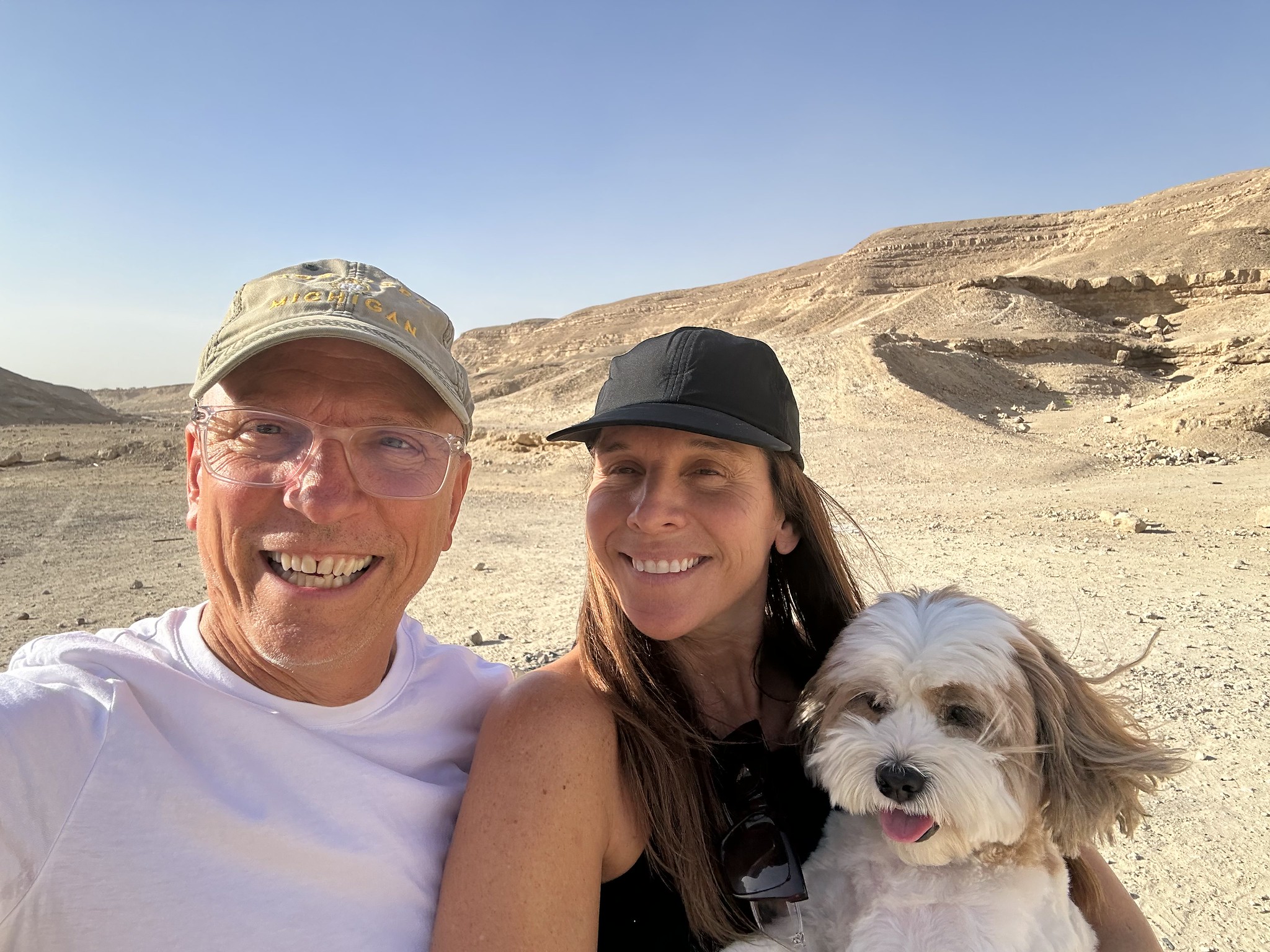
I will be posting a lot about my daughter over the next week or so as she completes her senior year at Tashkent International School. Ocean completed her last International Baccalaureate (IB) Diploma Programme (DP) Exams on Friday, May 15, with Paper 2 of the Mathematics Applications and Interpretation Standard Level course. She is our third child to go through the entire IB from start to finish. Our eldest son, Owen, scored 34 points in May 2021, surpassing his predicted score of 31. Oliver scored a 28 in May 2024. We’ll see how Ocean does. It really doesn’t matter in the long run, as an IB score doesn’t define success in your future professional and personal life. Young people mature and find purpose on different timelines. We always joke that the Kralovec children should “Strive for the 5”, an above-average score in the DP. We want them to enjoy their high school years and find academic success, but not at all costs.
The Diploma Programme has its critics, but it does expose high school students to university-level content and skills, especially in writing. They are better prepared for the rigors of university than their non-IB peers. It also gives a broad perspective with requiring 6 different subjects. My only criticism is that it should have more flexibility to include internships or practical work, and a bit less on the academic side. We are equally proud of all of them!
McEwan’s novel is set in a dystopian future in the year 2119. The polar ice caps have melted, causing much of the Earth to be underwater. Combined with nuclear disasters, it is a diminished world. Two university history professors, Tom and Rose, specialize in our current time, and specifically on the life of a great poet, Francis Blundy. He wrote a famous poem, “A Corona for Vivien,” that he read aloud at a party for his wife in 2014. Copies of the poem were lost to history, and Tom is obsessed with finding it. The world of 2119 is diminished, with England being an archipelago of small islands, travel is limited due to the fall of the rules-based order of the world and less fossil fuel use. He looks back longingly at the abundance and ignorance of societies that led to his world of the future.
He has a lot more data to work from than historians of the past. The entire internet and digital communications were saved. Tom can read emails, texts, social media posts, and even journals that were preserved. McEwan asks the reader in the title (What Can We Know) that even with all this information about the past lives of these people, there is still a lot that historians cannot know. In Part II of the book, there is a big plot twist, with Tom finding map coordinates as a clue in one of Vivien’s diaries. Buried under the location point, Tom and Rose find out about a crime Vivien committed and the consequences of that crime. Researchers could not learn about this through the mountains of correspondence and digital information. It made me think about how much we can actually know about the past. Take, for example, the historical Shakespeare or the historical Jesus; there is not a lot of data to go on to piece together their lives. I wonder how much of my life will be available for future generations? Most people are completely lost to history. On a more intimate level, people keep secrets, and how much do we really know about even people who are close to us?
Historians from 2119 call our era The Derangement (mass migration) and The Inundation (flooding), and I could see McEwan writing this book as a warning to us. He might think, like many people do, that human civilization is fraying at the edges and might be starting a downward spiral. Climate change will be a huge disruptive force in the future, and as McEwan imagines, could easily break down the systems humanity has built to support our flourishing. I see why we don’t reduce emissions into the environment; the pain it will cause is far (I hope) into the future.
I watched 28 Years Later (2025), another dystopian future, but this time, it is the “rage virus” that causes a zombie apocalypse. This is the third movie in the series. The first two were famous for having fast-moving zombies instead of the traditional, Thriller-like slow-moving zombies. In the 2025 film, the UK has been quarantined from mainland Europe, and no one can leave or enter. It is a coming-of-age film that features, “Spike”, who at 12 years old and lives in a civilized community on a small island off the coast of mainland England. They are protected by the sea and the tides. The community celebrates when a teenager makes his first visit to the mainland and gets his first kill of a zombie. An interesting twist, there are now “Alphas” that are huge, smarter zombies that can order zombie followers to attack humans. Spike leaves the community eventually to find a doctor on the mainland. Ralph Fiennes is brilliant as the eccentric doctor. I love apocalypse movies and zombies, so I recommend this. Boyle is famous for Trainspotting and Slumdog Millionaire, although I didn’t like the artistic imagery he added in this film. In researching this blog post, I discovered there is a fourth movie in the series that came out in January 2026. I’ll have to check it out.
The highlight of my first full day in Prague was a run through the Šárka Valley nature area in the hills above the Diplomat Hotel where we are staying for the meetings. It is an official nature reserve covering 247 acres of hills and forests with the Šarecký stream running through it. I ran about 6 kilometers of trails through the reserve. The area was deliberately reforested in the late 19th and early 20th century but park officials chose the Black Locust (I have that tree right outside my office in Tashkent!), which is not natural to this area. Conservationists are planting native species like oak, hornbeam and lindens.
The directors met for a dinner at the Three Fiddles Irish Pub after a long day of meetings.
I am visiting Prague, Czechia, for the first time this weekend. I am attending my final spring CEESA Directors’ meetings. It was originally scheduled for Baku, Azerbaijan, a much shorter flight, but due to Trump’s war in Iran, it was changed to Prague. Azerbaijan shares a border with Iran in the north.
View from Sixth Floor of Diplomat Hotel – Prague
The Czech Republic is special for me as it is the home of my great-grandfather, Andreas Kralovec, who immigrated to the USA from “Bohemia” in 1888. I am adopted and do not have any Czech DNA, but I feel a special pull to the country with my surname and my relationship with my father. I never met Andreas, nor my grandfather, as both died before I was born. I was thinking of my dad during the trip, he would have enjoyed the Pilsner at the monastery brewery and the sour kraut served with my duck.
View of Prague from Osada Baba
The flight departed on time from Tashkent at 9:30 AM. I got a lot of work done before the flight so feel like I put in a half day at school. I had a window seat and this particular Turkish Airlines plane, an Airbus 330 had more legroom and space than some other planes in their fleet. One of the challenges of belonging to CEESA, is Tashkent is on the far eastern side of the association, a long way from Central Europe where the meetings are being held. It is a 5 hour and 20 minutes flight from Tashkent to Prague.
Workbund 1930s Villa
I arrived at the hotel from the airport around 7:00 PM. It was cool and a bit rainy so I went for a walk out of the Diplomat Hotel. It is located out of the city center in the Hanspaulka neighborhood of Prague. I walked up and along the Osada Baba a ridge overlooking the Vlatava River Valley. There were some lovely 1930s villas that were part of the Werkbund Architektur Design Association. As you can see above, in the dying light, I did get a glimpse of the Prague Fortress. There were no tourists and it would be a lovely suburb to live in. The highlight of the walk was watching a rock band performance at an outdoor festival at a university near the hotel. College kids are the same the world over…
I finished Natasha Wimmer’s translation of “Tu Sueño Imperios Han Sido” by the Mexican author Alvaro Enrigue. He reimagines the first encounter of the Spanish military force led by the famous explorer Hernán Cortés and the Aztec leader Montezuma. The entire novel takes place in one day, November 8, 1519. My big takeaway from the book was thinking about the size and sophistication of the indigenous societies of ancient Mexico. The city of Tenochtitlan was bigger than most European cities at the time. Contact with European explorers was inevitable but I wonder what was lost and what it would look like today if the indigenous cultures had survived and thrived.
Enrigue does what all fiction writers do and takes liberties with the historical record. Moctezuma is a psychedelic-addicted, depressed, self-obsessed emperor. His sister, the queen, is running the government, and the Spaniards are dirty, country bumpkins compared to the locals. Hernando Cortés was a skilled military leader and used the enemies of the empire to ally with and eventually bring down the great city. Of course, smallpox was probably his biggest weapon, but he used firearms and horses, two things the Mexica had never seen before the arrival of the Spanish conquistadors. He did imagine what it would be like for the Spaniards to experience a city larger than any in Spain, with potable water, elaborate botanical gardens, a sewage system, and a level of urban organization they never seen. The military might, and immunity to disease, is what won the day for the Spanish.
My only complaint about the book was the names of the Aztecs. Enrigue uses the original indigenous languages. The Aztecs are known at the Mexica or Tenochca. Atotoxtli, Cuauhtémoc, Tenochtitlan, Cuitlahuac, Tlilpotonqui, Cihuacoatl, etc. I should have made a key card.
In the forward, Enrigue writes to Natasha, the translator, “With age comes insecurity, and I spend more time revising than writing.” I thought that one one gets older, because of experience, a person would be more confident. That is true in some realms, but Enrique’s quote rings true with me.
labret – a shell, bone, or object stuck into the lip, culturally decorative
Saturnalian (adj) – wild, boundary-free revelry, origins in the Roman celebration of the god Saturn.
consort – spouse or companion of a monarch
The word vainilla comes from the Spanish conquistadors because the seeds of the plant rattle in long pods, scabbard-like “vainas”. Vaina today is also used as a slang word in Colombia and Venezuela to mean a “thing” or “stuff” or “whatchamacalit”.
“in Mexico no one had conceived of the hinge” In the book, there were no doors in the Mexica’s great palace, they only used curtains.
tautology -is saying the same thing twice in different words, so that the second part adds no new information. The classic examples are phrases like “free gift,” “past history,” “end result”.
On the flights from Tashkent to Prague, I also watched the movie Nuremberg, starring Rami Malek and Russell Crowe. Malek plays a US military psychiatrist who is tasked with getting into the mind of Hitler’s number two, Hermann Göring. Crowe is brilliant; he is such a good actor. My big takeaway was that the US military was quite innovative in setting up a war crimes trial. This had never been done as in most cases, the victorious military either executes or imprisons the losing military leadership without a trial. This was the first time an international justice court was constructed. The Nuremberg Trials went on from November 20, 1945 to October 1, 1946 for 24 major Nazi war criminals. It tried lesser military officials for years, ending in April 1949. The court established the principle that individuals, including heads of state, can be held criminally responsible under international law. Before that, international law dealt almost exclusively with states as actors. It established the principles of “war crimes”, “crimes against humanity”, and “crimes of aggression”. In 1948, the Geneva Convention added a fourth category, “genocide”. It also established that “following orders” is not a valid defense. I thought a lot of about the International Criminal Court (ICC) that was formed through the principles of the Nuremberg Trials when I lived in Belgrade (2008 – 2014) as the ex-military officers were being tried in the Hague in the aftermath of the breakup of Yugoslavia.
The conference’s opening day was at the Pullman Hotel located in the exclusive neighborhood of Vake and its glorious Vake Park. Sean and I walked around the park, taking in the sights and sounds of a beautiful spring afternoon. It is a classic Soviet-era urban park that was originally called Victory Park and opened in 1946. There is a grand entrance with a long staircase leading up to the grave of the Unnamed Soldier, now the People’s Monument. The neighborhood was originally designed for Soviet intelligentsia, politicians, and scientists. Today it is an upscale neighborhood with 112,000 residents and is popular with expatriates, diplomats, and the Georgian professional class. The next time I am here I want to hike up to Turtle Lake (Kus Tba).
Makeshift bench in Saburtelo
I spent the last day working in Sean’s apartment in the outer suburb of Saburtelo. This is a growing area north west of the Tbilisi city center. He lives in a beautiful apartment complex completed in 2019. After I finished the school leadership team meeting, I went for a walk in the hills around the complex. It was an overcast day with heavy rains in the morning, but it was great to feel the fresh air walking around before an afternoon spent sitting in a plane. The city is expanding, and I can imagine that the now empty fields and scrub land will have more homes and apartment complexes.
View from Sean’s Apartment
Tbilisi and Georgia are one of my favorite places on the planet. The city has such a warm and edgy vibe, the people are really good-looking and interesting, and it is set in the mountains. The cuisine and wines are world-class – there is a lot to like about the country.
Historical fiction brings history to life. The technique is simple. Imagine the day-to-day events, motivations, reflections, relationships (basically being a human being) that are behind the historical facts one can read on a Wikipedia page or history textbook. I never thought I would be interested in reading about the life of the Austrian film director G.W. Pabst, who died four days after I was born in 1967. That is the magic of historical fiction, telling the human stories behind history.
Daniel Kehlmann’s book is an easy read because the German-language author’s writing is elegant and engaging. G.W. Pabst’s life is interesting in several ways. His film career coincides with film moving from silent movies to sound. Early in his career, he was ahead of his time and was one of the first directors to use the idea of “continuity” in movies. Examples of this include showing an actor looking off to her left, and then showing what she is looking at in the next film shot (eyeline match in film jargon). Another is showing an actor reaching to open the door and in the next shot, move the shot close in to show his hand twisting the doorknob (cutting the action). Today we take this for granted, but in the early days of film, directors used to let the scene end with a single shot and then clumsily change to the start of the next scene. It fascinates me how people use new technology to advance their craft. AI is the latest advancement we are dealing with now.
GW Pabst filming Paracelsus in 1943
Pabst’s life is also fascinating because he was visiting his sick mother in France at the outbreak of World War II. French authorities forced him and his family to go to Nazi Germany. Pabst made films in France and America prior to being forced back to his home in Austria and was not sympathetic to the National Socialist cause. Kehlmann captures the spirit of an artist trying to be creative and free under Goebel’s propaganda regime. I kept thinking of the Trump Presidency and his focus on culture in the USA. Nazi Germany is an extreme version of this. The book explores how people subdue their true beliefs and feelings in an authoritarian government. For many, it was comply and not offend, otherwise you would be sent to a work camp or worse.
The book also made me think about the fleeting nature of fame and pop culture. I have not seen or heard of any of the movies, actors, or directors featured in the book, except for the actress, Greta Garbo. I don’t watch movies from the silent era (1895-1929), and not many are popular almost a century after the era ended. I guess Charlie Chaplin and Buster Keaton are the two actors that most people know who they are. I also don’t watch films from the Golden Age of Hollywood (1930-1960), and those classic black-and-white films will eventually fade from popular culture like the silent films of the previous era. Even movies from my childhood (original Planet of the Apes for example) will face a similar fate. I will try to watch Pabst’s most famous movie, Pandora’s Box (1929), starring Louise Brooks (below)
Louise Brooks (Pandora’s Box 1929)
Kehlmann describes a large cast of characters on how they got by in Nazi Germany. From the people that were elevated (the lowly Pabst estate caretaker) to an English BBC journalist who made broadcasts aimed at England for the Nazis. One vignette that stood out was the use of concentration camp prisoners that served as extras in the two Pabst films he made during the war. I am interested in reading his other book about Alexander von Humboldt, the German geographer who mapped much of the interior of South America.
We had a nice weekend in Tashkent. It was a busy Saturday with our school hosting the Central Asia Federation of Athletics Volleyball Tournament. Ocean was watching her boyfriend Roman play on our U19 team. Sunday was spent cleaning, shopping and packing as we continue to wind our time down here in Uzbekistan. Nadia and I attended a performance of La Traviata, one of the most performed operas in the canon. I love the live music and singing, and Nadia tolerates it for me. This was a good one to attend because of the ties to one of her favorite movies, Pretty Woman starring Julia Roberts and Richard Gere. We watched it together when we first started dating and it matches the story of La Traviota, a rich nobleman falls in love with a courtesan. The director of this version set it in early-20th-century Paris and included a silent ghost figure who came and went during scenes. My ear is not good enough to critique the singing. I thought it was a top rate performance!
I had a rare mid-week long run on Wednesday afternoon. The fresh green of the trees, a light rain, and the freshness of the canal made for an exhilarating experience. I will definitely miss the Ankhor Canal. I wonder how many kilometers I’ve run/cycled on it over the past 7 years.
Mom, Ocean and Dad at the Lago Blanco Restaurant – Furqat Park – Tashkent
The Class of 2026 Grade 12 students celebrated their last day of regular classes with an assembly, clap-out, and lunch this past Wednesday. It was the end of an era for Nadia and me, with Ocean graduating next month, we will no longer have our children at school with us while we are working. Ocean is ready to be done with PK-12 education, and we are excited for her next step. However, it is sad that we now join the rest of the working world by not having our children at our workplace. Every day is Bring Your Child to Work Day with international school teachers. It was probably the biggest “perk” of being an international school educator for all these years. Just having the opportunity to glimpse them at lunch in the cafeteria or to really understand their lives was special.
Ocean will now be on study leave until IB exams start next week. I accompanied her to watch the volleyball championships this weekend we are hosting at our school. Nadia and I are supporting her as she finishes high school on a strong note.
Last Sunday, my friend Aaron and I hiked through the beautiful Aksakatasay River Canyon. The spring is the best time for exploring the mountains of Uzbekistan. The snow melt supports new green grasses and wildflowers before livestock and the dry heat of summer make it all disappear. The highest peaks still have snow this time of the year, providing a picturesque background. The drive from Tashkent to the village of Shuldak takes about 90 minutes, and you are in a world away from the city. Spring is also a time for Uzbek families and friends to head up to the mountains for picnics and socializing. Very few people here are into mountaineering and at this time of year, we hiked by different family groups and university students setting up BBQ or picnic areas near roads or two-track trails that have vehicle access. Aaron and I were the only serious hikers in the canyon on a gorgeous, sunny spring day in mid-April.
The Aksakatasay River flows from the mountains, draining a watershed of 453 square kilometers. The spring snowmelt created a fast-flowing river. The Aksakatasay eventually flows into the Chirchiq River, which Russian engineers used to create the Ankhor Canal System that flows through Tashkent. As you can see by the photos, the valley views are spectacular! We started from the parking area outside the village of Shuldak and slowly made our way from the river bed to about mid-canyon elevation. Walking up the sloping marble slabs, we encountered many Mollusca fossils. They date back to the Paleozoic Era when the area was the Turkestan Ocean. The tectonic plate collision created the Western Tien Shan Mountain Range.
Aksakatasay is a mouthful and let me break it down. Aksak originates from the Turkic language family and means “lame or limping”. ata is an honorific meaning “father” or “ancestor” that is common in Central Asia. Say is Uzbek for a “stream” or “seasonal watercourse”. In English, the Akskatasay would translate to the Lame Elder’s Stream or the Limping Father Stream. Aksakatasay sounds much more exotic.
One of the highlights of the hike was stopping for a shashlik (grilled meat sticks) with some locals. They were having a birthday picnic for their friend and showed us some Central Asian hospitality and insisted we have some meat and of course, a shot of vodka. It was a nice break at the top of the canyon. I also took a short nap a bit further down the mountain on a grassy spot with the warm sun and cool breeze relaxing me. It was an awesome and rejuvenating day!